Meta publishes a rate card. For a marketing template message delivered to an Indian phone number in 2026, that rate is ₹0.8631. It is public, it is the same for every provider, and you can read it on Meta's own developer documentation.
Depending on which platform you use, you might be paying ₹0.8631 — or ₹0.949, or ₹1.09.
This article explains why that gap exists, what the two partner models are called, and exactly what four named providers charge. Every figure comes from a published pricing page, linked so you can check it yourself.
Disclosure: WhatsMark is a WhatsApp platform and competes with several companies named here. That is precisely why every number below links to its source.
The short version
Provider | Marketing rate (India) | vs Meta's ₹0.8631 |
|---|---|---|
Meta (the baseline) | ₹0.8631 | — |
₹0.8631 | 0% | |
₹0.8631 | 0% | |
₹0.949 | +10.0% | |
₹0.958 | +11.0% | |
₹0.970 | +12.4% | |
₹1.03572 | +20.0% | |
₹1.09 | +26.3% |
The difference comes down to one structural thing: whether your provider holds a line of credit with Meta.
What is a WhatsApp BSP?
A Business Solution Provider is a company authorised by Meta to give other businesses access to the WhatsApp Business Platform. Meta does not open the API to everyone directly, so for years the BSP was the only route in.
The original BSPs were CPaaS companies — Twilio, MessageBird, Infobip — brought in to scale WhatsApp business messaging quickly.
Meta has since renamed them. Under the updated partner ecosystem, BSPs are officially called Solution Partners. Most of the industry still says "BSP", and both terms refer to the same thing.
Meta's own definition is worth reading closely, because one clause explains the entire pricing question:
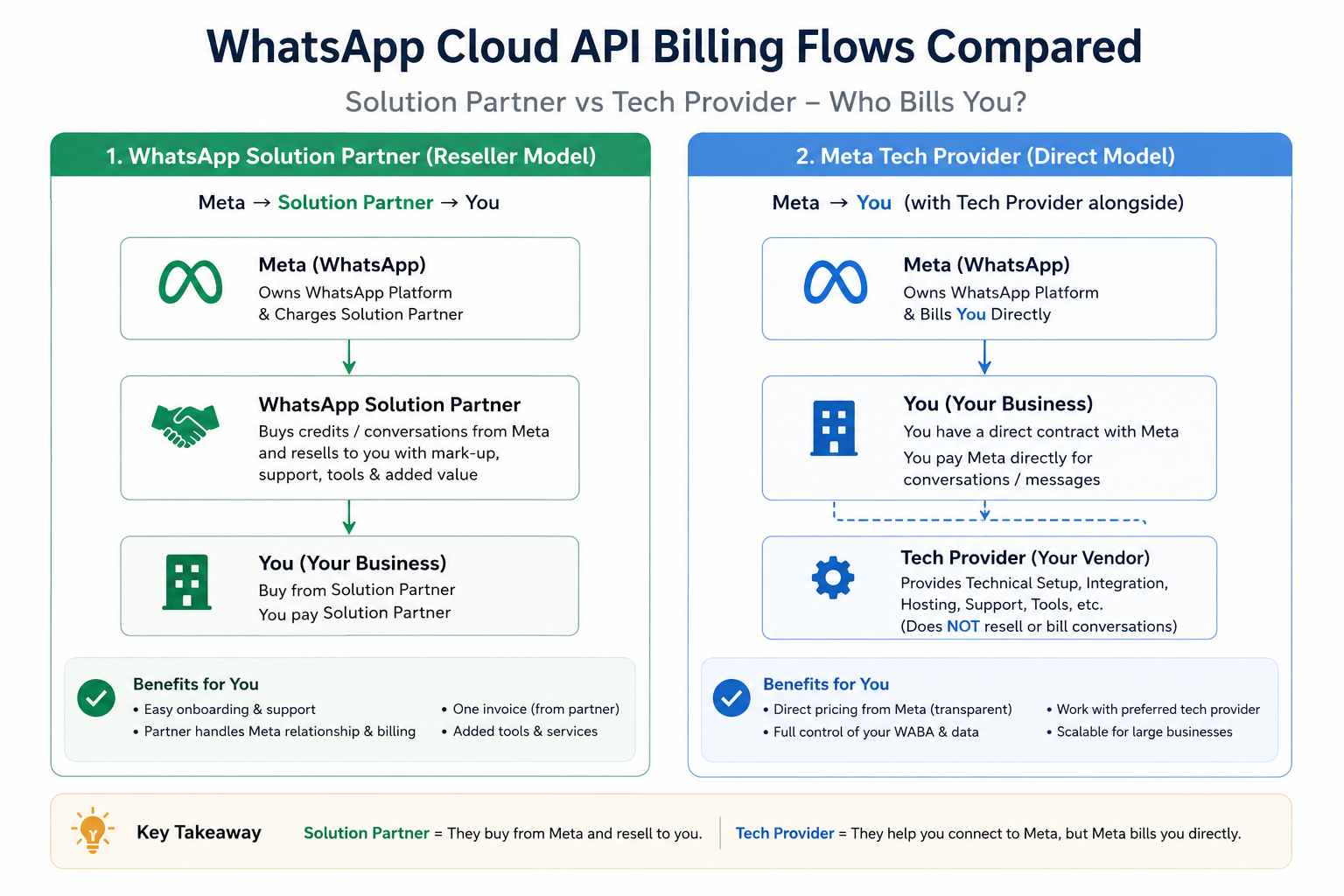
Solution Partners provide a full range of WhatsApp Business Platform services — messaging, billing, integration support, customer support. Solution Partners have credit lines which can be extended to clients they bring on board, removing the need for those clients to enter their own payment method. Solution Partners can also directly invoice their clients for the services provided through their apps.
That is the mechanism. The Solution Partner pays Meta first, using its own credit line, then invoices you. The difference between what Meta charges them and what they charge you is their margin.
What is a Meta Tech Provider?
A Tech Provider is a third-party developer that builds software on top of the WhatsApp Business Platform and integrates directly with Meta's Cloud API.
Meta's definition draws one sharp distinction: Tech Providers do not have credit lines. Clients onboarded by a Tech Provider must supply their own payment method after onboarding. Meta then bills those clients directly for API usage, and the Tech Provider bills separately for its own software.
The consequence is structural, not a policy choice: a Tech Provider cannot mark up your message fees, because it never handles your message bill. Meta charges your card. Your platform charges you for the platform. Two separate invoices, two separate relationships.
There is a third tier. Meta's progression runs third-party developer → Tech Provider → Tech Partner. A Tech Partner is an upgraded Tech Provider that has passed a further Meta review, which unlocks the SMB Accelerator Program and direct support.
Solution Partner vs Tech Provider — the differences that affect your bill
Dimension | Solution Partner (formerly BSP) | Tech Provider |
|---|---|---|
Line of credit from Meta | ✅ Yes | ❌ No |
Who invoices you for messages | The partner | Meta, directly |
Markup on messages possible | ✅ Yes | ❌ No |
You supply your own payment method | ❌ Not required | ✅ Required |
Consolidated single invoice | ✅ Yes | ❌ Two invoices |
SMB Accelerator Program eligible | ✅ Yes | ❌ Not unless upgraded |
Meta Direct Support | ✅ Yes | Limited |
Neither model is universally better. The credit line is a genuine convenience — some businesses cannot or will not put a card on file with Meta, and agencies often prefer one consolidated invoice per client. You are trading transparency for convenience, and that trade is reasonable at low volume.
At high volume, the arithmetic stops being reasonable. We will get to the numbers.
Meta's India rate card for 2026
Meta charges per delivered template message, and the rate depends on the recipient's country and the message category. These are the current India rates:
Message category | Meta's rate (India) | What it covers |
|---|---|---|
Marketing | ₹0.8631 | Promotions, offers, product announcements, re-engagement |
Utility | ₹0.115 | Order updates, receipts, delivery notifications, reminders |
Authentication | ₹0.115 | OTPs, account verification, account recovery |
Service | Free | Any reply inside the 24-hour customer service window |
Two changes worth knowing about:
On 1 January 2026, Meta raised the India marketing rate roughly 10%, from ₹0.7846 to ₹0.8631. Utility and authentication were unchanged.
On 1 April 2026, Meta raised the India authentication-international rate. Domestic authentication was unaffected.
The service window is the single biggest lever on your bill. When a customer messages you first, a 24-hour window opens and every reply you send inside it is free — no template required. Every new message from the customer resets the window. Businesses whose WhatsApp motion is inbound and conversational pay dramatically less than businesses that lean on outbound marketing blasts.
Note on GST. In India, 18% GST applies on both Meta's charges and your platform fee. Meta's charges are treated as imported OIDAR services. Budget for it — it is not included in any rate quoted in this article.
What each provider actually charges
Every rate below is taken from the provider's own published pricing page in July 2026. Where a provider does not publish a rate, we say so rather than estimating.
AiSensy — approximately 26% above Meta, uniformly
Category | Meta charges | AiSensy charges | Difference |
|---|---|---|---|
Marketing | ₹0.8631 | ₹1.09 | +26.3% |
Utility | ₹0.115 | ₹0.145 | +26.1% |
Authentication | ₹0.115 | ₹0.145 | +26.1% |
The markup is close to identical across all three categories, which suggests a deliberate uniform margin rather than rounding. AiSensy's pricing page presents these as the applicable rates and states that conversation credits are charged directly by Meta.
AiSensy also prices its chatbot builder and AI agents as separate add-ons — ₹2,500/month and ₹3,500/month respectively — on top of the platform subscription.
How WhatsMark compares: we bill Meta's ₹0.8631 and ₹0.115 with no markup, and the chatbot builder and AI flow generation are included in the plan rather than sold separately. On 50,000 marketing messages a month, the message-fee difference alone is ₹136,140 a year — before counting the ₹6,000/month of add-ons.
Interakt — markup that shrinks as you pay more
Interakt publishes per-message rates for each tier directly on its pricing page. The pattern is the interesting part:
Tier | Marketing | vs Meta | Utility | vs Meta | Authentication | vs Meta |
|---|---|---|---|---|---|---|
Meta baseline | ₹0.8631 | — | ₹0.115 | — | ₹0.115 | — |
Starter — ₹3,499/qtr | ₹0.970 | +12.4% | ₹0.160 | +39.1% | ₹0.129 | +12.2% |
Growth — ₹7,699/qtr | ₹0.958 | +11.0% | ₹0.150 | +30.4% | ₹0.128 | +11.3% |
Advanced — ₹10,499/qtr | ₹0.949 | +10.0% | ₹0.140 | +21.7% | ₹0.127 | +10.4% |
Enterprise — on request | "No Markup Charges" | 0% | — | — | — | — |
How WhatsMark compares: our rate is ₹0.8631 marketing and ₹0.115 utility on every plan — including the free one. There is no tier at which the markup improves, because there is no markup to improve. A business on our free plan pays the same message rate as one on the reseller plan.
Two things stand out.
The markup decreases as the subscription gets more expensive, and only reaches zero at the Enterprise tier, which Interakt lists explicitly as "No Markup Charges".
Utility messages carry the heaviest markup, and the cheapest plan is marked up the most. A utility message on Starter costs ₹0.160 against Meta's ₹0.115 — a 39.1% premium. The smallest customers, on the cheapest plan, pay the highest percentage over Meta's rate.
360dialog — zero markup
360dialog's pricing page states plainly that there is no markup on Meta fees, and its Partner Platform advertises zero message markup. The model is a flat fee per number per month — €49, €99 or €249 depending on tier — with Meta's messaging fees billed separately and passed through unchanged.
This matters beyond 360dialog itself. It proves that zero markup is a viable business model, not a promotional gimmick. Any claim that markup is simply unavoidable in this industry is wrong.
The trade-off is real: 360dialog is API infrastructure. There is no shared team inbox, no chatbot builder, no campaign manager. You bring your own software layer.
How WhatsMark compares: we match 360dialog on message pricing — Meta's rates, zero markup — but include the software layer they leave to you: shared WhatsApp and Messenger inbox, visual flow builder, campaign manager and WhatsApp Flows. If you have engineering capacity and only need the pipe, 360dialog is a clean choice. If you need the pipe and the product, that combination is what we built.
Wati — a fixed multiplier on Meta's rate card
Wati does not show per-message rates on its pricing page. They live in a downloadable rate card, and the card is plan-specific. Here is the India row from the Growth plan card:
Category | Meta charges | Wati Growth charges | Difference |
|---|---|---|---|
Marketing | ₹0.8631 | ₹1.03572 | +20.0% |
Utility | ₹0.115 | ₹0.14950 | +30.0% |
Authentication | ₹0.115 | ₹0.14950 | +30.0% |
Those percentages are not approximations. ₹0.8631 × 1.20 = ₹1.03572 exactly. ₹0.115 × 1.30 = ₹0.14950 exactly. Both match Meta's published rates to five decimal places.
Wati applies a fixed multiplier to Meta's entire rate card — 20% on marketing, 30% on utility and authentication — across every country in the table. The rate card is Meta's own pricing run through a formula.
This card covers the Growth plan. Wati publishes separate cards for Pro and Business, so multipliers may differ by tier.
Wati's Indian plan pricing is ₹2,199/month for Growth (3 users, and no additional users can be purchased), ₹4,899 for Pro (5 users, then ₹1,299/user/month) and ₹14,799 for Business (5 users, then ₹2,199/user/month), each billed annually.
How WhatsMark compares: no message markup and no per-seat charge. Wati's Growth plan caps you at three users with no option to add a fourth; ours does not cap agents at all. A ten-person support team on Wati Pro pays ₹4,899 plus ₹1,299 for each of the five extra seats — ₹11,394/month before a single message is sent.
The pattern nobody advertises: utility costs you most
Line the three providers up on a single category and something consistent appears.
Marketing messages — the rate everyone quotes:
Provider | Rate | Over Meta |
|---|---|---|
Meta baseline | ₹0.8631 | — |
Interakt Advanced | ₹0.949 | +10.0% |
Interakt Growth | ₹0.958 | +11.0% |
Interakt Starter | ₹0.970 | +12.4% |
Wati Growth | ₹1.03572 | +20.0% |
AiSensy | ₹1.09 | +26.3% |
Utility messages — the rate nobody checks:
Provider | Rate | Over Meta |
|---|---|---|
Meta baseline | ₹0.115 | — |
AiSensy | ₹0.145 | +26.1% |
Wati Growth | ₹0.14950 | +30.0% |
Interakt Starter | ₹0.160 | +39.1% |
Every provider marks up utility messages harder than marketing messages. Wati charges 20% over Meta on marketing and 30% on utility. Interakt's Starter plan charges 12.4% on marketing and 39.1% on utility — more than triple the premium.
Utility messages are your OTPs, order confirmations, delivery updates and appointment reminders. Because Meta prices them so cheaply — ₹0.115 against ₹0.8631 for marketing — most businesses never scrutinise the line. A 30% premium on a message that costs eleven paise doesn't feel like anything.
It adds up. A logistics business sending 200,000 delivery notifications a month pays ₹23,000 at Meta's rate and ₹29,900 at Wati's Growth rate. That is ₹82,800 a year on the category nobody negotiates.
When you compare providers, ask for all three rates, not just marketing. The headline rate is the one that gets advertised. The utility rate is the one that quietly costs more.
Percentages feel abstract. Rupees do not.
Here is a business sending 50,000 marketing messages a month to Indian numbers — a mid-size D2C brand running weekly campaigns to a 12,000-contact list.
Route | Message fees per year | Over three years |
|---|---|---|
Meta's published rate | ₹517,860 | ₹1,553,580 |
Interakt Advanced (+10.0%) | ₹569,400 | ₹1,708,200 |
AiSensy (+26.3%) | ₹654,000 | ₹1,962,000 |
₹408,420 over three years separates the top and bottom rows. That is message fees alone, before a single rupee of platform subscription, and before GST.
At 100,000 messages a month, the same gap is over ₹816,000.
The markup scales with your success. Your subscription is fixed; your message volume is not. A campaign that performs well and doubles your sends also doubles the amount of markup you pay. It is the one line on your invoice that grows precisely when things are going right.
How to check whether your provider marks up
Four steps. Ten minutes.
Step 1 — Find Meta's rate for your recipient country. Go to Meta's WhatsApp Business Platform pricing documentation. Rates are set by the recipient's country, not where your business is registered. If you message Indian customers, you pay India rates regardless of where you are.
Step 2 — Find your provider's per-message rate. Look at your invoice, your dashboard's billing section, or your provider's rate card. If the rate is not published anywhere and support will not send it in writing, treat that as an answer in itself.
Step 3 — Divide. Your provider's rate ÷ Meta's rate. Anything above 1.00 is markup. A result of 1.26 means you are paying 26% over Meta.
Step 4 — Multiply by your annual volume. Take the difference per message, multiply by monthly volume, multiply by twelve. That number is what the markup costs you per year.
One caution when comparing quotes: always ask whether a quoted per-message rate is Meta's rate or Meta-plus-markup. Two providers can quote wildly different platform fees, and the one with the cheaper subscription can easily be more expensive overall once message volume is included.
Which model should you actually choose?
Honest answer: it depends on volume and on whether you need a credit line.
A Solution Partner makes sense when:
You cannot or prefer not to put a payment method on file directly with Meta
You want one consolidated invoice rather than two separate bills
You are an agency that needs to bill clients for messages under your own name
Your monthly volume is low enough that a 10–26% markup is a small absolute number
You want the partner to absorb billing failures and payment retries on your behalf
A Tech Provider makes sense when:
You send more than a few thousand messages a month, where markup compounds meaningfully
You want to see exactly what Meta charges, separately from what your software costs
You want your WhatsApp Business Account to stay portable if you change software later
You would rather the platform compete on features than on billing opacity
The rule of thumb: below a few thousand messages a month, the convenience of a credit line is usually worth the markup. Above that, the markup compounds while a flat platform fee does not, and the Tech Provider model wins on arithmetic.
Common questions
Is a WhatsApp BSP the same as a Solution Partner? Yes. Meta renamed Business Solution Providers to Solution Partners under its updated partner ecosystem. Both terms describe the same partner type — one that holds a line of credit with Meta and can invoice clients directly.
Do all WhatsApp BSPs charge a markup? No. Markup is common but not universal. 360dialog charges Meta's rates with no markup and bills a flat per-number platform fee instead. Most Indian providers add somewhere between 10% and 30%.
What is Meta's WhatsApp marketing rate in India in 2026? ₹0.8631 per delivered marketing template message, effective 1 January 2026. Utility and authentication are ₹0.115 each. Service messages sent inside the 24-hour customer service window are free.
Can I pay Meta directly for WhatsApp API usage? Yes, if you onboard through a Meta Tech Provider. Tech Providers do not hold a credit line, so you add your own payment method and Meta bills you directly at published rates.
Does GST apply on top of Meta's charges? Yes. In India, 18% GST applies to both Meta's message charges and your platform's subscription fee. Meta's charges are treated as imported OIDAR services.
How do I find out whether my provider is a Solution Partner or a Tech Provider? Check who invoices you for messages. If your platform bills you for message usage, it is operating as a Solution Partner. If Meta charges your card directly and your platform bills only for software, it is a Tech Provider.
What is a line of credit in this context? It is a facility Meta extends to Solution Partners, letting them pay Meta for message usage and then recover that cost from their clients. It is what allows a client to onboard without entering a payment method — and it is also the mechanism that makes markup possible.
Which message category carries the highest markup? Utility, at every provider we checked. Wati's Growth plan charges 20% over Meta on marketing but 30% on utility. Interakt's Starter plan charges 12.4% on marketing and 39.1% on utility. Because Meta prices utility messages at ₹0.115 against ₹0.8631 for marketing, the premium is easy to overlook — but at high transactional volume it compounds.
Which model is cheaper at 100,000 messages a month? The Tech Provider model, in almost every case. At that volume a 26% markup on India marketing messages adds roughly ₹22,690 a month over Meta's rate — around ₹272,000 a year — while a flat platform fee stays flat.
The bottom line
The partner model your provider operates under determines whether a markup on your messages is even structurally possible. Solution Partners hold a credit line, pay Meta first, and invoice you — and the spread is where markup lives. Tech Providers never touch your message bill, so there is nothing to mark up.
Neither model is dishonest. But you are entitled to know which one you are on, and what it costs.
Meta's rates are public. Your provider's rates should be too. If you cannot find your provider's per-message rate in ten minutes of looking, that is worth asking about.
Where WhatsMark sits: we bill Meta's published rates with no markup, on every plan including the free one, and no per-seat charge on any plan. The chatbot builder, AI flow generation, shared WhatsApp and Messenger inbox and WhatsApp Flows are included rather than sold as add-ons. If you want the transparency of the Tech Provider model without giving up the software layer, that is the gap we built into.
Rates verified July 2026 against Meta's published rate card and each provider's public pricing page. Vendor pricing changes frequently — check the linked sources for current figures.